
Last updated: May 2026 · 10 min read
If you're a UK business owner looking to outsource to India from the UK, you're not alone. Thousands of British companies — from startups to established SMEs — are turning to India to solve their hiring challenges, reduce costs, and access world-class talent that's increasingly difficult to find domestically.
But here's the thing: "outsourcing" means different things to different people. And the model you choose will determine whether you get a reliable, long-term team — or a frustrating experience with inconsistent quality and communication gaps.
This guide covers everything you need to know: the different models available, realistic costs, legal considerations, and how to choose the right approach for your business.
Why UK Businesses Are Outsourcing to India in 2026
Outsourcing to India from UK businesses has grown significantly over the past five years — and 2026 is seeing the strongest demand yet.
The UK is facing a persistent skills shortage. According to the Open University Business Barometer, 78% of UK organisations have experienced a skills gap in the past 12 months. Meanwhile, hiring costs continue to rise — the average cost-per-hire in the UK now exceeds £3,000, with technical roles taking 8–12 weeks to fill.
The UK skills shortage is driving more companies toward remote hiring India as a sustainable long-term solution. According to ManpowerGroup's 2025 Talent Shortage Survey, 80% of UK employers report difficulty finding skilled talent — the highest level in over a decade.
India offers a compelling alternative:
- Cost savings of 60–80% compared to UK salaries for equivalent roles
- 4.5-hour time zone overlap with GMT (IST is +5:30) — enabling real-time collaboration during UK afternoons
- 5.8 million+ developers alone, plus hundreds of thousands of accountants, marketers, and specialists
- English-speaking workforce — India produces over 1.5 million English-speaking graduates annually
- Proven track record — India has been the world's #1 outsourcing destination for over two decades
The 4 Models for Outsourcing to India from the UK
Not all outsourcing is created equal. Here are the four main approaches UK businesses use — and the pros and cons of each:
1. Traditional BPO (Business Process Outsourcing)
You hand over an entire process (e.g., customer support, data entry) to an Indian BPO company. They manage everything — you have limited control over individual workers.
- ✅ Hands-off management
- ❌ No control over who works on your account
- ❌ Quality can be inconsistent
- ❌ Not suitable for skilled/specialist roles
2. Freelance Platforms (Upwork, Fiverr)
You hire individual freelancers from India on a project or hourly basis.
- ✅ Cheap for one-off tasks
- ❌ No commitment — freelancers juggle multiple clients
- ❌ Quality varies wildly
- ❌ No infrastructure, HR, or backup if they disappear
3. Recruitment Agencies
You pay a recruitment agency to find candidates in India. You then employ them directly (requiring an Indian entity) or use a separate EOR.
- ✅ Access to vetted candidates
- ❌ High per-placement fees (15–25% of annual salary)
- ❌ No ongoing support after placement
- ❌ You handle compliance, payroll, and management
4. Managed Remote Staffing (Dedicated Employees + EOR)
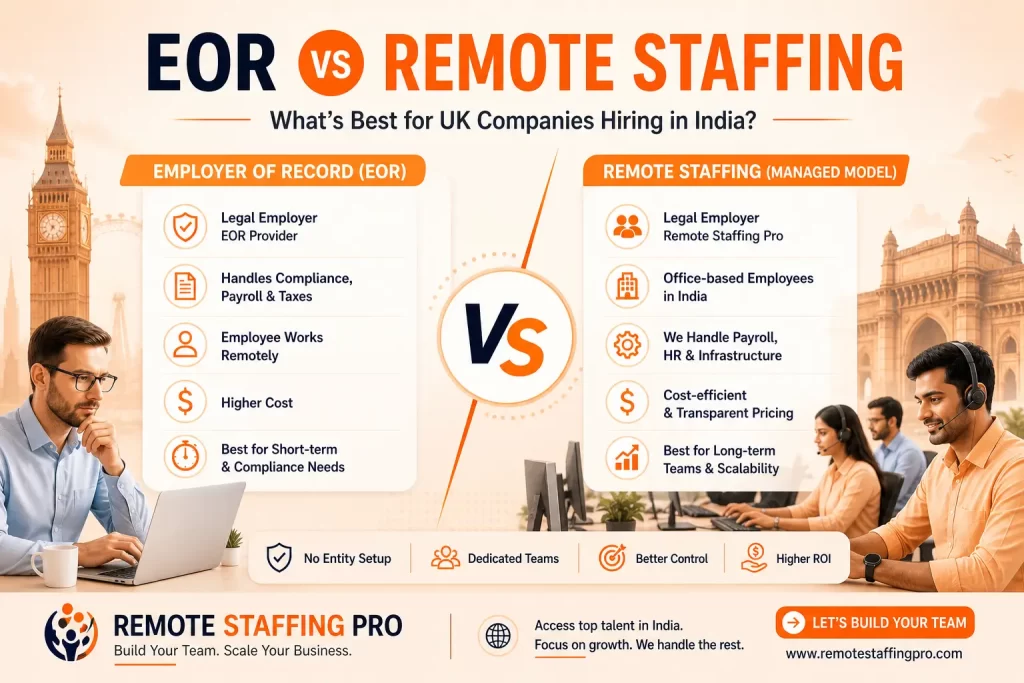
A managed staffing partner recruits, employs, and hosts dedicated full-time employees who work exclusively for your business — from a professionally managed office in India. The partner acts as your Employer of Record (EOR), handling payroll, compliance, HR, and infrastructure.
- ✅ Dedicated employees — not shared, not freelancers
- ✅ You retain full control over work, priorities, and output
- ✅ No Indian entity needed — the partner handles all compliance
- ✅ Professional office environment with enterprise-grade IT
- ✅ Built-in redundancy, HR support, and replacement guarantees
💡 Key Insight: If you're looking for long-term, reliable team members (not one-off tasks), managed remote staffing India delivers the best combination of quality, control, and cost savings. It's not traditional "outsourcing" — it's building your own dedicated team in India, without the legal complexity.
When comparing India vs Philippines outsourcing UK, India wins on talent pool size (5.8M+ developers vs 190K), English proficiency, and time zone overlap (4.5 hours vs 8 hours difference from GMT).
How Much Does It Cost to Outsource to India from the UK?
Wondering about the real outsource to India UK cost? Here's a realistic comparison for common roles UK businesses hire for:
| Role | UK Salary (Annual) | India via Managed Staffing (Annual) | Savings |
|---|---|---|---|
| Software Developer | £45,000 – £75,000 | £8,000 – £18,000 | ~75% |
| Digital Marketing Specialist | £35,000 – £55,000 | £6,000 – £12,000 | ~78% |
| Accountant / Bookkeeper | £30,000 – £50,000 | £5,000 – £10,000 | ~80% |
| Virtual Assistant | £22,000 – £30,000 | £4,000 – £7,000 | ~77% |
| Graphic Designer | £28,000 – £45,000 | £5,000 – £10,000 | ~78% |
| HR / Recruitment Specialist | £32,000 – £50,000 | £5,000 – £11,000 | ~78% |
Note: India costs shown are employee salaries. With a managed staffing partner like RemoteStaffingPro, you pay the employee salary plus a transparent management fee covering office, IT, HR, and EOR compliance. No hidden costs. See how UK SMEs hiring remote staff from India are saving 60–75% and scaling their teams in weeks — read our complete 2026 scaling guide.
Legal Considerations: Do You Need an Indian Entity?
This is one of the biggest concerns UK businesses have — and the answer depends on your model:
| Model | Indian Entity Required? | UK Tax Implications |
|---|---|---|
| Direct employment in India | Yes — you need a registered entity | Complex — permanent establishment risk |
| Freelancer contracts | No — but IR35 risk if misclassified | Must ensure genuine self-employment |
| Managed staffing with EOR | No — the EOR partner employs them | Clean — service invoice from Indian company |
With a managed staffing partner acting as your Employer of Record, you receive a simple monthly invoice for services rendered. There's no permanent establishment risk, no Indian payroll obligations, and no need to navigate Indian labour law. Your UK accountant treats it as a standard overseas service expense.
Time Zone: Can You Actually Collaborate with an Indian Team?
India Standard Time (IST) is 5 hours 30 minutes ahead of GMT (4 hours 30 minutes ahead during BST). In practice, this means:
- Your Indian team's working hours: 9:00 AM – 6:00 PM IST
- Overlap with UK hours: 12:30 PM – 6:00 PM GMT (or 1:30 PM – 6:00 PM BST)
- Daily synchronous collaboration: 4.5–5.5 hours
This is more than enough for daily standups, real-time Slack communication, video calls, and collaborative work sessions. Many UK companies find this overlap ideal — their Indian team completes work overnight, and they review it each morning with fresh eyes.
Step-by-Step: How to Outsource to India from the UK (The Right Way)
Here's the process if you choose the managed staffing route:
- Define your requirements — Role, skills, experience level, working hours, and any specific tools/software needed
- Choose a managed staffing partner — Look for: EOR capability, managed office (not work-from-home), transparent pricing, no long-term lock-in, replacement guarantee
- Review shortlisted candidates — Your partner shortlists 3–5 candidates matching your requirements. You receive CVs and conduct interviews yourself
- Select and onboard — Choose your preferred candidate. Your partner handles employment contracts, payroll setup, and office onboarding
- Start working together — Your dedicated employee starts full-time from the managed office. You assign tasks, set priorities, and manage output directly via your preferred tools (Slack, Teams, Asana, etc.)
- Pay monthly — Simple monthly invoice: employee salary + management fee. No surprises.
Typical timeline from requirement to start: 2–3 weeks.
What Roles Can UK Businesses Outsource to India?
Almost any knowledge-work role that doesn't require physical presence in the UK can be staffed from India. Want to outsource software development to India UK? Developers are the most popular role, but the options extend far beyond tech. The most popular roles UK companies hire include:
- Software Developers — React, Node, Python, Java, .NET, PHP, mobile app development
- Digital Marketing Specialists — PPC, social media, content marketing, email campaigns
- SEO Specialists — Technical SEO, link building, content optimisation
- Accountants & Bookkeepers — Xero, QuickBooks, VAT returns, management accounts
- Virtual Assistants — Admin support, calendar management, research, data entry
- Graphic Designers — Brand design, social media creatives, UI/UX, presentations
- HR & Recruitment Specialists — Talent sourcing, screening, onboarding support
Common Mistakes UK Businesses Make When Outsourcing to India
Avoid these pitfalls to ensure a successful experience:
- Choosing the cheapest option — Rock-bottom rates often mean inexperienced workers or shared resources. Pay fair market rates for dedicated, quality professionals.
- Not conducting interviews — Always interview candidates yourself. A good partner will facilitate this, not skip it.
- Unclear communication expectations — Define upfront: which tools you'll use, response time expectations, meeting schedules, and reporting cadence.
- Treating remote staff differently — Your Indian team members should feel like part of your company. Include them in team meetings, share context, and invest in the relationship.
- Ignoring data security — Ensure your partner has proper security measures: NDAs, encrypted systems, access controls. A managed office environment is inherently more secure than work-from-home setups.
Why Managed Remote Staffing Beats Traditional Outsourcing
If you've read this far, you'll notice a theme: the managed staffing model solves virtually every problem associated with traditional outsourcing. Here's the comparison:
| Factor | Traditional Outsourcing/BPO | Managed Remote Staffing |
|---|---|---|
| Control over work | Limited — vendor manages | Full — you direct your team |
| Dedicated employees | Shared across clients | 100% dedicated to you |
| Quality consistency | Variable | You choose who you hire |
| Transparency | Black box | Full visibility into work |
| Scalability | Vendor-dependent | Add/remove as needed |
| Long-term contracts | Usually required | Month-to-month flexibility |
| Compliance/legal | Your responsibility | EOR partner handles everything |
For UK companies ready to hire remote staff India UK, the managed model eliminates every traditional outsourcing headache.
Ready to Build Your Dedicated Team in India?
RemoteStaffingPro helps UK businesses hire dedicated full-time employees from India — with full EOR support, managed office infrastructure, and transparent monthly pricing. No entity needed. No long-term lock-in. Start in 2–3 weeks.
Explore UK Remote Staffing →Frequently Asked Questions
Is it legal to outsource to India from UK businesses?
Yes, absolutely. UK businesses can legally engage Indian service providers or use an Employer of Record to hire Indian employees. There are no restrictions on purchasing services from India. With a managed staffing partner handling employment, you receive a standard service invoice — no different from any other overseas supplier.
How do I pay my Indian team?
With a managed staffing partner, you don't pay employees directly. You pay one monthly invoice (in GBP or USD) to your partner, who handles all salary disbursements, taxes, and statutory contributions in India.
What about data protection and GDPR?
India is not on the UK's list of adequate countries for data transfers. However, this is easily managed through Standard Contractual Clauses (SCCs) and appropriate technical measures. A good managed staffing partner will have these frameworks pre-configured — including NDAs, encrypted systems, and physical office security.
Can I outsource accounting to India UK?
Yes — and it's one of the most popular roles. Indian accountants are proficient in Xero, QuickBooks, Sage, and UK-specific requirements like VAT returns, MTD compliance, and management accounts. Learn more about hiring remote accountants from India.
How do I manage someone in a different time zone?
With 4.5–5.5 hours of daily overlap between UK and India, real-time collaboration is straightforward. Use tools like Slack, Microsoft Teams, or Google Meet for communication. Set clear daily/weekly priorities, and establish a reporting rhythm that works for both sides.
Final Thoughts
Outsourcing to India from the UK doesn't have to mean losing control, dealing with inconsistent quality, or navigating complex legal structures. The managed remote staffing model gives you the best of both worlds: significant cost savings with the control and quality of an in-house team.
Whether you need developers, digital marketers, virtual assistants, or accountants — India's talent pool is deep, English-speaking, and ready to work as a dedicated extension of your UK business.
The question isn't whether to outsource to India from the UK. It's which model gives you the reliability, quality, and control your business deserves.