Last updated: May 2026 · 12 min read
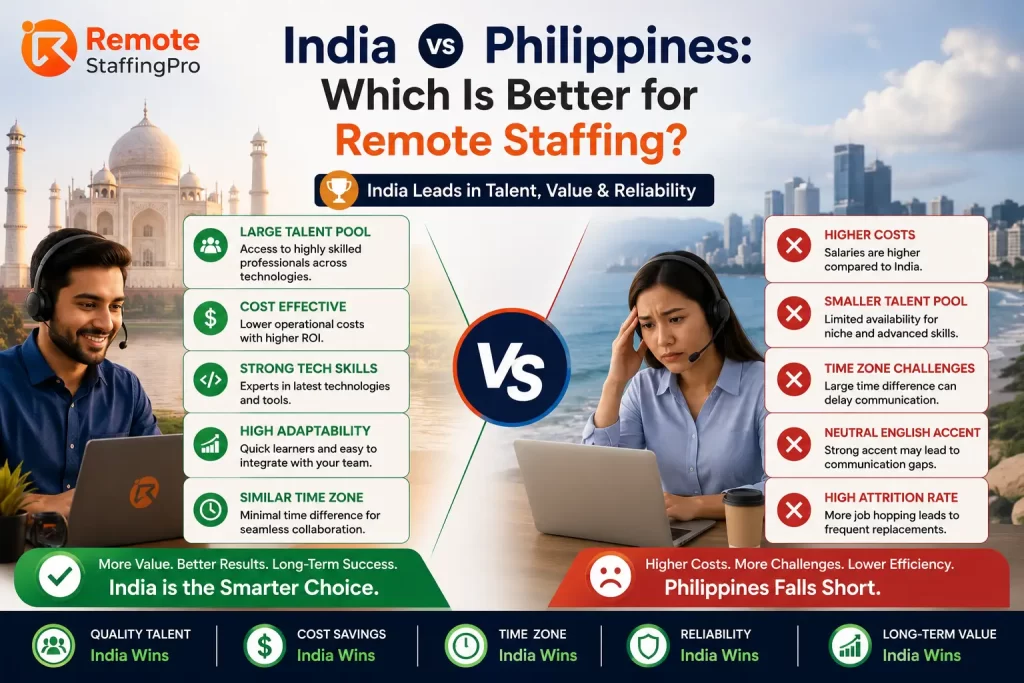
When businesses decide to build a remote team offshore, two countries dominate the conversation: India and the Philippines. Both offer English-speaking talent at significantly lower costs than domestic hiring — but they're very different in terms of talent depth, scalability, specialisation, and infrastructure.
This India vs Philippines outsourcing comparison covers everything you need to know — from costs and talent pools to time zones and infrastructure — to help you decide which is the better fit for your India vs Philippines remote staffing needs. Whether you're based in the USA, UK, Australia, or UAE, this guide will help you make the right decision.
India vs Philippines: At a Glance
| Factor | India 🇮🇳 | Philippines 🇵🇭 |
|---|---|---|
| Population | 1.44 billion | 117 million |
| IT/Tech workforce | 5.8 million+ developers | ~190,000 developers |
| English proficiency | High (business English) | High (American-accented) |
| Primary strengths | IT, accounting, engineering, marketing | Customer support, admin, VA |
| Average developer salary | $15,000 – $30,000/year | $12,000 – $22,000/year |
| Time zone (GMT offset) | +5:30 | +8:00 |
| Infrastructure reliability | Tier-1 cities: excellent | Variable (typhoon-prone) |
| Scalability | Virtually unlimited | Limited for specialist roles |
Talent Pool: Depth and Specialisation
This is where the India vs Philippines comparison becomes most stark.
India's Talent Advantage
When comparing India vs Philippines for developers, India's 5.8M+ pool dwarfs the Philippines' ~190K — giving you access to virtually any technology stack at any experience level. India produces over 1.5 million engineering graduates annually and has the world's second-largest pool of software developers. Beyond tech, India's talent pipeline includes:
- 40,000+ new chartered accountants every year
- Hundreds of thousands of digital marketing, SEO, and design professionals
- Deep specialisation in AI/ML, cloud architecture, data science, and fintech
- Strong STEM education — IITs and NITs produce world-class engineers
Philippines' Talent Strength
The Philippines excels in:
- Customer service and voice support — American-accented English, cultural affinity with the US
- Administrative and VA roles — strong work ethic, detail-oriented
- Content moderation and data entry
However, for specialist technical roles — software development, accounting, digital marketing, HR — India's talent pool is 10–30x larger and more experienced. According to NASSCOM's 2025 Strategic Review, India's technology sector employs over 5.8 million professionals — making it the world's largest IT talent hub after the United States.
🏆 Winner — Talent Pool: India (for specialist/technical roles) | Philippines (for voice-based customer support)
Cost Comparison: India vs Philippines
Many businesses assume the Philippines is cheaper. The reality is more nuanced — when you compare offshore staffing costs India vs Philippines for equivalent skill levels:
| Role | India (Annual) | Philippines (Annual) | Difference |
|---|---|---|---|
| Software Developer (Mid-level) | $18,000 – $30,000 | $15,000 – $25,000 | ~15% cheaper in PH |
| Senior Developer / Architect | $30,000 – $50,000 | Scarce — limited availability | India wins (availability) |
| Accountant / Bookkeeper | $8,000 – $15,000 | $10,000 – $16,000 | ~15% cheaper in India |
| Digital Marketing Specialist | $10,000 – $18,000 | $9,000 – $15,000 | Similar |
| Virtual Assistant | $5,000 – $9,000 | $6,000 – $10,000 | ~10% cheaper in India |
| Customer Support (Voice) | $5,000 – $8,000 | $5,000 – $8,000 | Similar (PH preferred for accent) |
💡 Key Insight: The cost difference between India and Philippines is marginal (5–15%) for most roles. The real differentiator isn't price — it's availability of specialist talent at scale. India offers unlimited scalability for technical roles that simply don't exist in sufficient numbers in the Philippines.
Time Zone Overlap: Which Works Better for Your Market?
Time zone compatibility depends entirely on where your business is located. Here's how India vs Philippines time zone overlap compares for major markets:
| Your Location | Overlap with India (IST +5:30) | Overlap with Philippines (PHT +8:00) | Better Fit |
|---|---|---|---|
| 🇬🇧 UK (GMT/BST) | 4.5–5.5 hours | 1–2 hours | India |
| 🇪🇺 Europe (CET) | 5–5.5 hours | 2–3 hours | India |
| 🇦🇪 UAE (GST +4) | 7+ hours (only 1.5hr gap) | 4–5 hours | India |
| 🇦🇺 Australia (AEST +10/11) | 4–5.5 hours | 5–6 hours | Philippines (slight edge) |
| 🇺🇸 US East (EST -5) | 1–3 hours | 0–1 hours | India (handoff model) |
| 🇺🇸 US West (PST -8) | 0–1 hours | 0 hours | Similar (both use handoff) |
Remote staffing India for UK businesses offers 4.5–5.5 hours of daily synchronous overlap — more than enough for standups, collaborative sessions, and real-time communication during UK afternoons.
🏆 Winner — Time Zone: India wins for UK, Europe, and UAE markets. Philippines has a slight edge for Australia. Both require handoff models for US West Coast.
English Proficiency and Communication
Both countries have strong English skills, but with different characteristics:
| Factor | India | Philippines |
|---|---|---|
| Accent | Neutral/British-influenced | American-influenced |
| Written English | Excellent — strong technical writing | Good — conversational strength |
| Business communication | Formal, detailed, documentation-oriented | Friendly, relationship-oriented |
| Best for | Technical docs, reports, B2B communication | Customer-facing calls, chat support |
If your remote staff will be handling customer-facing voice calls with American customers, the Philippines has an edge. For everything else — written communication, technical documentation, B2B interactions, internal team collaboration — India's English proficiency is equally strong or stronger.
Infrastructure and Business Continuity
This is an often-overlooked factor in the India vs Philippines remote staffing decision:
India
- Tier-1 cities (Bangalore, Hyderabad, Pune, Chennai) have world-class IT infrastructure
- Redundant internet connectivity, power backup, and enterprise-grade office parks
- Minimal natural disaster risk in major tech hubs
- Managed office environments with 99.9% uptime guarantees
Philippines
- Metro Manila has good infrastructure, but typhoon season (June–November) causes regular disruptions
- Average of 20 typhoons per year, with 5–6 causing significant damage
- Internet speeds and reliability are lower outside Metro Manila
- Power outages more frequent than in Indian tech hubs
🏆 Winner — Infrastructure: India. Major tech hubs offer enterprise-grade reliability with minimal natural disaster risk. This matters significantly for business continuity.
Scalability: Can You Grow Your Team?
If you plan to scale from 1–2 people to a team of 10, 20, or 50+ — this factor becomes critical:
| Scaling Factor | India | Philippines |
|---|---|---|
| Developer availability | 5.8M+ (virtually unlimited) | ~190K (limited) |
| Accountant availability | 40,000+ new CAs annually | Limited CPAs |
| Niche specialists (AI, data science) | Abundant | Very scarce |
| Hiring speed (time to fill) | 2–3 weeks | 2–4 weeks |
| Multi-role teams | Easy — all roles available | Difficult for technical roles |
If you need a diverse team — say, 3 developers + 1 accountant + 1 digital marketer + 1 VA — India can staff all roles from a single managed office. In the Philippines, you'd likely find the VA easily but struggle with the specialist roles.
Which Roles Should You Hire Where?
Here's a practical guide based on where each country genuinely excels:
✅ Hire from India
- Software Developers — all stacks, all levels
- Accountants & Bookkeepers — Xero, QuickBooks, IFRS, local compliance
- Digital Marketing Specialists — PPC, SEO, content, social media
- SEO Specialists — technical SEO, link building, analytics
- Graphic Designers — UI/UX, brand design, motion graphics
- HR & Recruitment Specialists — talent sourcing, screening
- Virtual Assistants — research, admin, project coordination
- Data Scientists, AI/ML Engineers, Cloud Architects
For India vs Philippines virtual assistant hiring, both countries perform equally well — but India offers the added advantage of scaling into specialist roles from the same team and office if your needs grow.
✅ Hire from Philippines
- Customer support (voice/phone — especially for US customers)
- Chat support agents
- Content moderation
- Basic data entry
Why the Staffing Model Matters More Than the Country
Here's what most comparison articles miss: the staffing model you choose matters more than the country. A poorly managed team in either country will underperform. A well-managed, dedicated team will deliver exceptional results regardless of location.
The key factors that determine success:
- Dedicated employees (not shared across clients)
- Professional office environment (not work-from-home)
- Your direct management (not a vendor managing on your behalf)
- EOR/compliance handled (so you focus on work, not paperwork)
- Transparent pricing (salary + management fee, no hidden costs)
This is exactly the managed remote staffing model — and it's what separates successful offshore teams from failed outsourcing experiments.
The Verdict: India vs Philippines for Remote Staffing
| If You Need... | Choose | Why |
|---|---|---|
| Software developers | India | 30x larger talent pool, all stacks available |
| Accountants/bookkeepers | India | 40,000+ new CAs/year, global compliance expertise |
| Digital marketing/SEO | India | Deeper specialisation, data-driven approach |
| Voice-based customer support (US) | Philippines | American accent, cultural affinity |
| Virtual assistants | Both (equal) | Both countries excel here |
| Scalable multi-role teams | India | All roles from one location |
| UK/Europe/UAE time zone | India | 4.5–7+ hours overlap vs 1–3 hours |
| Business continuity | India | No typhoon risk, enterprise infrastructure |
💡 Bottom Line: If you need voice-based customer support for American customers, the Philippines is a strong choice. For virtually everything else — development, accounting, marketing, design, HR, and scalable teams — India offers the deeper talent pool, better infrastructure, and stronger time zone alignment for UK, European, and Middle Eastern businesses.
Ready to Hire Remote Staff India?
RemoteStaffingPro provides dedicated full-time employees from India — working from a professionally managed office with enterprise-grade infrastructure. No freelancers. No shared resources. Your team, your way.
Get Started — Free Consultation →Frequently Asked Questions
Is India cheaper than the Philippines for remote staffing?
For most roles, costs are similar (within 5–15%). India is slightly cheaper for accountants and VAs, while the Philippines is marginally cheaper for entry-level developers. The real difference isn't cost — it's talent availability and specialisation depth.
Which country has better English skills?
Both have strong English proficiency. The Philippines has a more American-sounding accent (ideal for US voice support). India has stronger written/technical English (ideal for B2B communication, documentation, and professional services).
Can I hire a mixed team from both countries?
Yes, but managing teams across two countries adds complexity. Most businesses find it more efficient to consolidate in one location. If your needs are primarily technical/specialist, India covers all roles from a single managed office.
Which is better for Australian businesses?
Remote staffing India for Australia works well with 4–5.5 hours of daily overlap with AEST — more than sufficient for daily collaboration. The Philippines has a slight time zone advantage (1–2 hours closer), but for specialist roles (developers, accountants), India's talent depth makes it the stronger choice for Australian companies hiring remote staff.
What about data security?
India has stronger data protection infrastructure in managed office environments — biometric access, encrypted systems, CCTV monitoring, and NDA-bound employees. India's IT industry has decades of experience handling sensitive data for global enterprises (banking, healthcare, legal). Both countries require proper contractual safeguards regardless.
Final Thoughts
The India vs Philippines remote staffing debate doesn't have a one-size-fits-all answer. But for the majority of businesses seeking specialist talent — developers, accountants, digital marketers, SEO specialists, and virtual assistants — India offers the deeper talent pool, better infrastructure, and stronger time zone alignment for UK, European, and Middle Eastern businesses.
The key to success isn't just choosing the right country. It's choosing the right staffing model — one that gives you dedicated employees, professional infrastructure, and full control over your team's output.