
The definitive guide for businesses in the UK, USA, UAE, Australia, and New Zealand looking to build high-performing remote teams in India.
In 2026, the question is no longer whether global companies should consider remote staffing from India—it’s how quickly they can get started. With India’s outsourcing services market reaching USD 137.66 million in 2025 and projected to grow at 10.83% CAGR through 2034, the momentum is undeniable. Companies from the UK, USA, UAE, Australia, and New Zealand are all increasing their share of India-based hiring, and for good reason.
India holds approximately 17.58% of the global software outsourcing market—nearly one-fifth of all offshore software services delivered worldwide. But this isn’t just about software anymore. From designers and accountants to customer support specialists and marketing managers, remote staffing solutions from India now span every business function. From startups to enterprises, offshoring to India has become the go-to strategy for building cost-effective, high-performing teams.
Let’s explore why forward-thinking companies across the globe are making this strategic shift to choose managed remote staffing from India.
1. The Massive Cost Advantage (Without Compromising Quality)
The most compelling reason companies choose offshore staffing from India is the dramatic cost savings. Companies hiring remote employees from India typically save 70–90% compared to in-house hiring in the US, UK, or Australia. Dedicated staff costs range from just $800–$3,500 per month for most business roles.
To put this in perspective:
- A senior software developer in the US costs $120,000–$180,000/year. In India, the same calibre of talent costs $25,000–$45,000/year.
- Indian developer hourly rates range between $15 and $50 depending on experience and skills—a fraction of Western rates.
- Companies save an average of $11,000 per year per part-time remote worker on overhead alone.
The cost of hiring remote employees in India isn’t just about salaries. You eliminate expenses related to office space, equipment, benefits administration, recruitment fees, and the hidden costs of a bad hire. When you partner with a remote staffing agency like Remote Staffing Pro, even these operational costs are handled for you.
Real Numbers: India vs. Western Markets
| Expense Category | USA / UK / Australia | India (via Remote Staffing Pro) |
|---|---|---|
| 💰 Monthly Salary (Mid-Level Developer) | $8,000 – $12,000 | $2,000 – $3,500 Save 70%+ |
| 🏢 Office Space per Employee | $500 – $1,500/mo | Included ✓ Save 100% |
| 👥 Recruitment Costs | $5,000 – $15,000/hire | Included ✓ Save 100% |
| 📋 Payroll & Compliance | Internal HR team needed | Fully Managed ✓ Save 100% |
| 💻 Equipment & IT Setup | $2,000 – $5,000 | Included ✓ Save 100% |
2. Access to a World-Class, English-Speaking Talent Pool
India produces over 1.5 million engineering graduates annually, alongside hundreds of thousands of business, design, and management professionals. The country’s tech demand has reached 1.8 million roles—up 16% year-on-year—demonstrating the depth and breadth of available talent. India’s tech industry is on track to reach $315 billion.
What makes India’s talent pool uniquely attractive for global companies:
- English proficiency: India is the world’s second-largest English-speaking country, making communication seamless with UK, US, Australian, and NZ teams.
- Technical education: India’s IITs, NITs, and private engineering colleges produce graduates trained in cutting-edge technologies.
- AI and emerging tech: AI hiring roles in India grew 15% in 2025, with projections of 380,000 AI positions in 2026—a 32% rise. This means you can hire remote developers from India with specialised AI, machine learning, and data science skills. See exactly what it costs to hire a remote developer from India.
- Diverse skill sets: Beyond tech, India offers world-class talent in graphic design, digital marketing, finance, HR, legal support, and customer service.
When you hire remote employees from India through a staffing partner, you’re not limited to whoever responds to a job posting. You get access to pre-vetted, interview-ready candidates matched specifically to your requirements.
3. Zero Hiring Hassles: How the Model Works
One of the biggest barriers to offshore hiring is the perceived complexity. How do you find the right person? How do you manage someone in a different country? What about contracts, legalities, and cultural differences?
This is where a dedicated remote team model eliminates the friction entirely. Here’s how it works with Remote Staffing Pro:
Step 1: Share Your Requirement
You tell us exactly what role you need—whether it’s a UI/UX designer for your London agency, a full-stack developer for your New York startup, or an accountant for your Dubai firm.
Step 2: We Source & Shortlist
Our recruitment team identifies candidates from India’s vast talent pool who match your technical requirements, experience level, and cultural fit. We send you shortlisted CVs.
Step 3: You Interview & Select
You conduct interviews directly with the candidates—just as you would with any local hire. You choose the person you want to work with.
Step 4: We Handle Everything Else
Once you select your candidate, we hire them under our payroll. They work from our fully-equipped office premises in India, dedicated exclusively to your projects. You communicate with them daily for tasks and management.
Step 5: Simple Monthly Payment
You pay us the employee’s salary plus a transparent service fee. We handle payroll, compliance, office infrastructure, IT equipment, and HR management.
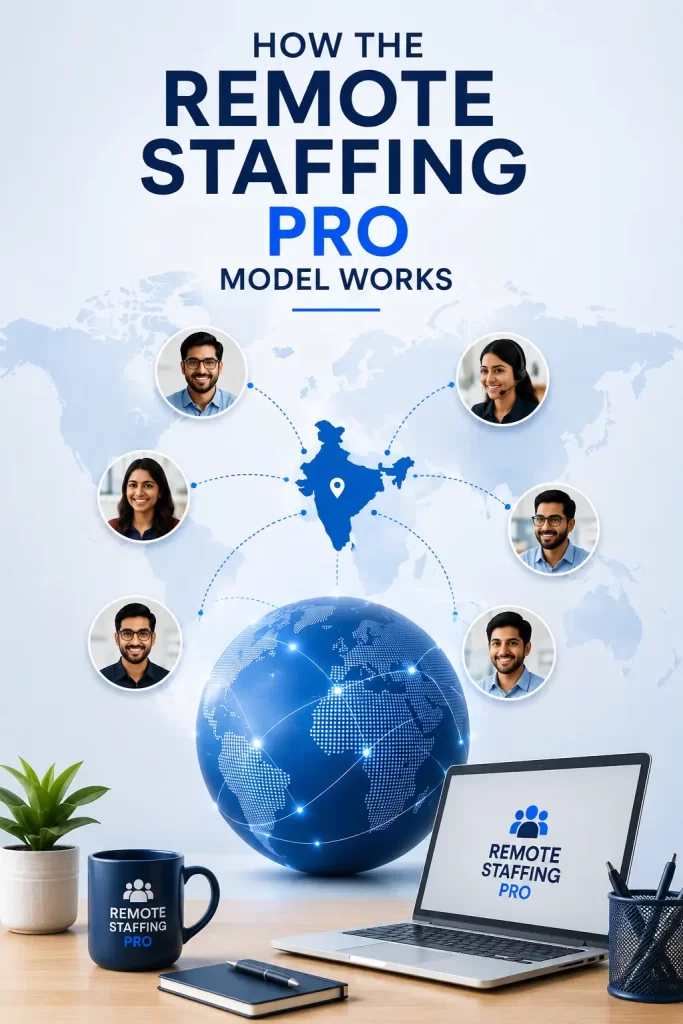
This model gives you the control of a direct hire with none of the administrative burden of managing an international employee.
4. India's Evolving Role: From Cost Centre to Strategic Hub
The narrative around offshoring to India has fundamentally shifted. India has evolved from a cost-effective offshoring centre into a value-adding strategic hub, now accounting for 57% of the global offshoring market.
The Rise of Global Capability Centres (GCCs)
The most telling indicator of India’s strategic importance is the explosive growth of Global Capability Centres. Approximately 50 new GCCs opened in India in just the first two quarters of 2025, with 1,700 GCCs now employing 1.9 million people. The GCC ecosystem is projected to reach $98.4 billion by FY26.
What does this mean for your business? If Fortune 500 companies are building entire capability centres in India, the talent ecosystem supporting them is world-class. When you build a dedicated remote team India, you’re tapping into the same talent pool that serves Google, Microsoft, JPMorgan, and hundreds of other global giants.
The Terminology Is Changing—And That Matters
The industry is moving away from “outsourcing” toward more accurate terms:
- UK companies prefer “staff augmentation” and “recruitment partnerships”
- UAE businesses use “manpower solutions” and “cross-border hiring” (which has surged 85% in the region)
- Australian firms favour “offshoring” and “offshore teams”
- US companies increasingly reference “distributed teams” and “global hiring”
This shift reflects reality: when you hire remote employees from India through Remote Staffing Pro, you’re not outsourcing a task—you’re building a distributed team who work exclusively for you.
5. Payroll, Compliance & Infrastructure: Fully Managed
For companies in the UK, USA, UAE, Australia, and New Zealand, navigating Indian employment law is a significant concern. India is prioritising workforce formalisation and digital governance, with individual states setting their own employment rules that vary by job type and industry.
What We Handle So You Don't Have To:
- Payroll processing: Monthly salary disbursement, tax deductions (TDS), and statutory contributions (PF, ESI, gratuity)
- Employment compliance: Adherence to India’s four consolidated labour codes covering wages, social security, industrial relations, and occupational safety
- Office infrastructure: Your employee works from our professional office with high-speed internet, power backup, ergonomic workstations, and IT support
- HR management: Leave management, performance documentation, employee engagement, and retention
Why This Matters for International Companies
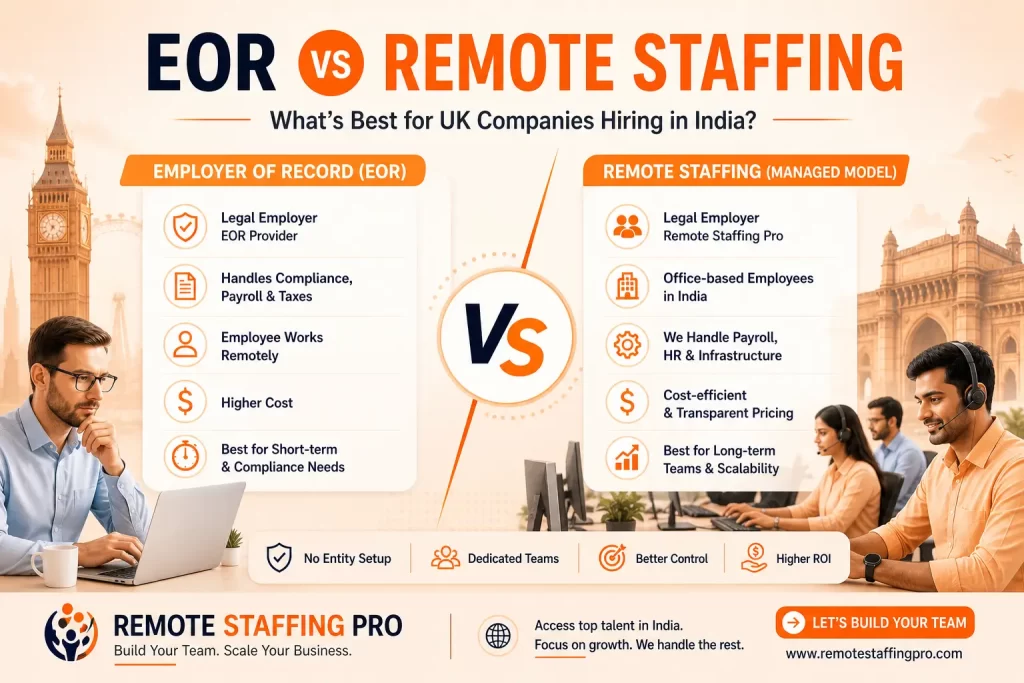
Setting up a legal entity in India takes 3–6 months and costs $20,000–$50,000+. Employer of Record (EOR) services offer an alternative, but they come with per-employee monthly fees that add up quickly. With Remote Staffing Pro’s model, you get full compliance coverage as part of your service—no entity setup, no EOR fees, no legal headaches.
6. Time Zone Advantage: Overlap That Works
One concern companies have about hiring remote staff from India is the time zone difference. In reality, India’s time zone (IST, UTC+5:30) offers strategic advantages:
| Your Location | Time Difference | Overlap Hours | Rating |
|---|---|---|---|
| 🇦🇪 UAE (GST) | +1.5 hours | Full Day | ★ Excellent |
| 🇬🇧 UK (GMT/BST) | +4.5 – 5.5 hours | 4–5 hours | ★ Great |
| 🇦🇺 Australia (AEST) | +4.5 – 5.5 hours | 4–5 hours | ★ Great |
| 🇳🇿 New Zealand (NZST) | +6.5 – 7.5 hours | 3–4 hours | ★ Good |
| 🇺🇸 USA East (EST) | −10.5 hours | 2–3 hours | ★ Good |
| 🇺🇸 USA West (PST) | −13.5 hours | Extended Coverage | ★ Good |
For UAE companies, the time zone alignment is nearly perfect. For UK and Australian businesses, there’s substantial natural overlap. For US companies, Indian teams can provide extended coverage or work adjusted hours for real-time collaboration.
7. Scalability: Grow Your Team Without Growing Your Headaches
Whether you need one dedicated designer or a team of twenty developers, remote staffing from India scales effortlessly:
- Start small: Begin with a single hire to test the model
- Scale fast: Add team members in 2–4 weeks (vs. 2–4 months for local hiring)
- Stay flexible: Scale down without the legal and emotional complexity of layoffs in your home country
- Specialise on demand: Need an AI engineer for 6 months? A data analyst for a specific project? Staff augmentation from India makes it possible.
92% of G2000 companies already use IT outsourcing, and 37% of small businesses outsource at least one business process. The model is proven at every scale.
8. Who Should Consider Remote Staffing from India?
This model works exceptionally well for:
Industries We Serve:
Getting Started with Remote Staffing Pro
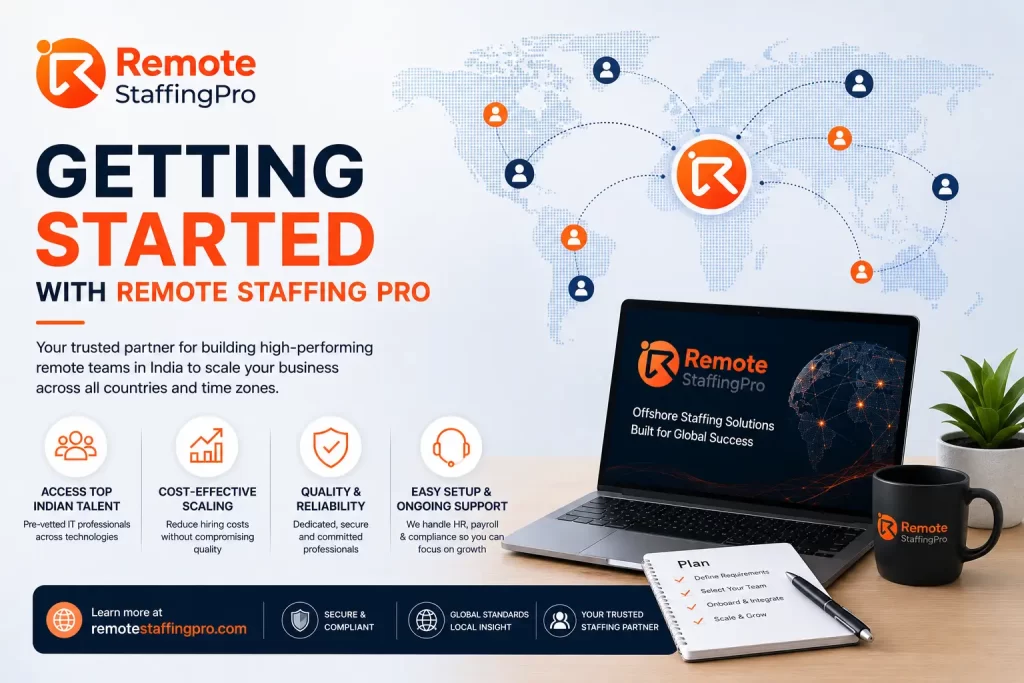
Building your dedicated remote team India doesn’t have to be complicated. Here’s what makes Remote Staffing Pro different:
✅ You choose your team — We shortlist, you interview and select
✅ Dedicated employees — They work exclusively for you, not shared across clients
✅ Professional infrastructure — Our office, our equipment, your team
✅ Complete compliance — Payroll, taxes, labour law—all handled
✅ Transparent pricing — Employee salary + service fee. No hidden costs.
✅ Direct communication — Talk to your team daily, assign tasks, manage projects your way
The Bottom Line
The global shift toward remote staffing from India isn’t a trend—it’s a structural transformation in how businesses build teams. With cost savings of 70–90%, access to 1.8 million+ tech professionals (and growing), zero compliance headaches, and a proven model trusted by companies of all sizes, the question isn’t why you should consider it—it’s why haven’t you started yet?