A comprehensive guide for global companies looking to hire talent in India without setting up a local company — covering EOR, contractors, managed staffing, and PEO options.
Introduction — Why Companies Want to Hire in India Without Setting Up an Entity
India is home to one of the world's deepest talent pools in engineering, design, marketing, finance, and operations — at compensation levels significantly below the US, UK, or Europe. It's no surprise that thousands of global companies are looking to tap into this talent.
But here's the challenge: setting up a legal entity in India is expensive, time-consuming, and creates long-term obligations that many companies — especially startups, SMEs, and those making their first few hires — simply don't need.
The good news? In 2026, you have multiple proven pathways to legally hire employees in India without registering a company. This guide breaks down each option, the pros and cons, and helps you choose the right model for your business.

Why Setting Up a Legal Entity in India is Complex
Before we explore the alternatives, let's understand why companies avoid entity setup in the first place:
- Time-consuming: Registering a Private Limited company in India involves incorporation under the Companies Act 2013, opening local bank accounts, obtaining tax registrations (GST, PAN, TAN), and registering for PF/ESI. This process can take 3–6 months.
- Expensive: Between legal fees, accounting setup, registered office requirements, and ongoing compliance costs, you're looking at significant upfront and recurring investment.
- Ongoing obligations: Once registered, you must file annual returns, maintain statutory records, conduct audits, and comply with Indian labour laws — even if you only have 1–2 employees.
- Exit is painful: Winding down an Indian entity is notoriously slow, often taking 1–2 years.
For companies making their first 1–10 hires in India, the overhead simply doesn't justify the investment. That's where the following options come in.
Option 1: Employer of Record (EOR) — The Fastest Compliant Route
What is an EOR?
An Employer of Record is a locally registered Indian company that legally employs staff on your behalf. The EOR signs employment contracts directly with your employees, manages payroll in INR, handles statutory contributions (Provident Fund, ESI, Professional Tax), deducts TDS, and files all statutory returns — while you retain full operational control over the employee's daily work, targets, and performance.
How it works:
- You identify and select the candidate
- The EOR onboards them as a legal employee under Indian law
- The EOR runs monthly payroll, benefits, and compliance
- You manage the employee's day-to-day work
- You pay the EOR a monthly fee (typically per employee)
Key benefits:
- Hire in as little as 7–14 days — no entity registration required
- Full compliance with Indian labour laws, PF, ESI, gratuity, and tax obligations
- Zero legal liability on your end for employment matters
- Easy to scale up or down
Ideal for:
- Companies making their first 1–10 hires in India
- Businesses that need full-time, dedicated employees (not freelancers)
- Companies that want compliant hiring without long-term entity commitments
Cost considerations:
EOR fees typically range from $99–$599 per employee per month, on top of the employee's salary and approximately 15–20% in employer statutory costs (PF, ESI, gratuity).

Option 2: Contractor/Freelancer Agreements — Simple but Risky
What is it?
You engage an individual in India as an independent contractor rather than an employee. They invoice you for services, and you pay them directly — no employment relationship exists on paper.
How it works:
- You draft a contractor/freelancer agreement
- The individual works on defined deliverables or hours
- They invoice you (often in USD/GBP/EUR)
- They handle their own taxes in India
Key benefits:
- Simplest and cheapest to set up
- No payroll, PF, ESI, or compliance obligations
- Flexible — easy to engage and disengage
The risks:
- Misclassification: If the contractor works fixed hours, uses your tools, reports to your manager, and works exclusively for you — Indian authorities may reclassify them as an employee. This carries real penalties.
- No IP protection: Without a proper employment contract under Indian law, intellectual property ownership can be murky.
- No loyalty or retention: Contractors can leave anytime, work for competitors, and have no obligation to your company.
- No benefits: You can't offer health insurance, paid leave, or retirement benefits — making it harder to attract top talent.
Ideal for:
- Short-term projects with defined deliverables
- Specialist work (consulting, advisory)
- When you need 1–2 people for less than 6 months
Option 3: Managed Remote Staffing — The Best of Both Worlds
What is it?
A managed remote staffing partner (like Remote Staffing Pro) hires employees under their own payroll and infrastructure, while you get a dedicated team member who works exclusively for you.
How it works:
- You share your staffing requirements
- The staffing partner shortlists candidates and sends CVs
- You interview and select the candidate
- The staffing partner hires them under their payroll
- The employee works from the partner's office premises (or remotely)
- You pay the employee's salary plus a management fee monthly
Key benefits:
- No legal entity needed — the staffing partner is the legal employer
- Dedicated employees who work exclusively for your company
- Full HR, payroll, and compliance handled for you
- Office infrastructure, IT setup, and management included
- Easy to scale from 1 to 50+ employees
- Better retention than contractors — employees get full benefits
How it differs from EOR:
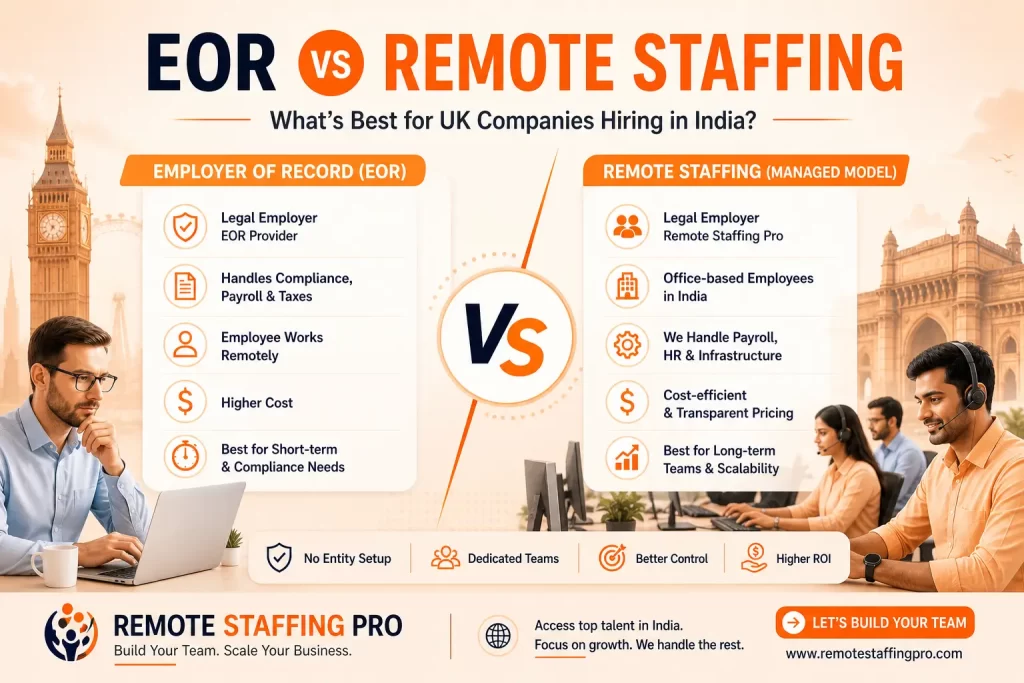
While EOR is purely a legal/payroll wrapper, managed staffing includes recruitment support, office space, HR management, IT infrastructure, and ongoing employee engagement. It's a more hands-off, turnkey solution.
Ideal for:
- Companies that want dedicated, full-time remote employees
- Businesses that don't want to manage HR, office, or infrastructure
- Companies scaling teams in India (developers, designers, marketers, accountants, VAs)
- Those who want a single partner handling everything end-to-end
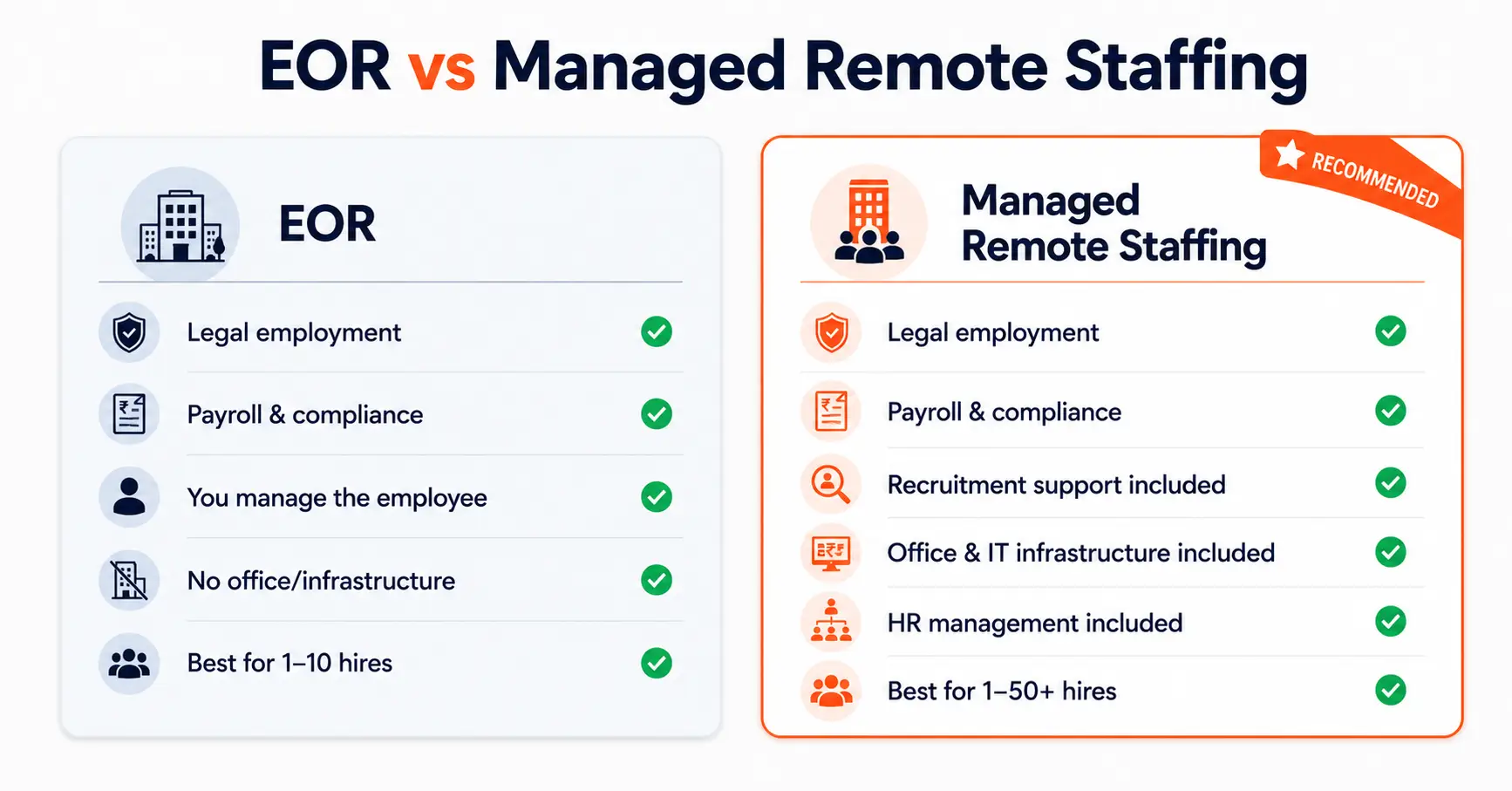
Learn more about how managed remote staffing works and why companies choose this model.
Option 4: Professional Employer Organization (PEO) — Co-Employment Model
What is it?
A PEO is a co-employment arrangement where the PEO shares HR responsibilities with your company. However, unlike an EOR, a PEO typically requires you to already have a registered entity in India.
How it works:
- You have (or set up) a basic legal presence in India
- The PEO co-employs your staff, handling payroll, benefits, and HR administration
- You share employment liability with the PEO
Key differences from EOR:
- PEO = co-employer (shared liability, requires your entity)
- EOR = sole legal employer (full liability on EOR, no entity needed from you)
Key benefits:
- Shared HR burden and compliance support
- Access to better employee benefit plans through pooled resources
- Useful if you already have an Indian entity but want HR support
Limitations:
- You still need a registered Indian entity in most cases
- Shared liability means you're not fully insulated from compliance risks
- Less suitable for companies with zero presence in India
For most international companies hiring in India for the first time, EOR or managed staffing is the better choice over PEO.
How to Choose the Right Model for Your Business

| Factor | EOR | Contractor | Managed Staffing | PEO |
|---|---|---|---|---|
| Need Indian entity? | No | No | No | Yes (usually) |
| Time to first hire | 7–14 days | 1–3 days | 1–3 weeks | 2–4 weeks |
| Compliance risk | Low | High | Low | Medium |
| Best for team size | 1–10 | 1–2 | 1–50+ | 5+ |
| Employee benefits | Yes | No | Yes | Yes |
| IP protection | Strong | Weak | Strong | Strong |
| Monthly cost | Medium | Low | Medium-High | Medium |
| Level of control | High | High | Medium-High | High |
| Infrastructure included | No | No | Yes | No |
Choose EOR if: You want to hire 1–10 employees quickly with full compliance, and you'll manage them directly.
Choose Contractor if: You need short-term, project-based help and understand the misclassification risks.
Choose Managed Staffing if: You want dedicated employees with full infrastructure, HR, and management support — a truly hands-off solution.
Choose PEO if: You already have an Indian entity and want to outsource HR/payroll administration.
How Remote Staffing Pro Can Help
We make hiring in India simple, compliant, and risk-free for global companies.
- ✅ Recruitment & candidate shortlisting
- ✅ Employment under our payroll (fully compliant)
- ✅ Office infrastructure & IT setup
- ✅ HR management & employee engagement
- ✅ Payroll, PF, ESI & all statutory compliance
No legal entity needed. No compliance headaches. Just great talent, working for you.
We serve companies in the USA, UK, Australia, Europe, and UAE.
Contact Us Today →Also explore our Employer of Record India service for a lightweight, compliance-first hiring solution.
FAQs
Yes. Through an Employer of Record or managed staffing partner, you can legally employ full-time staff in India without any company registration. The EOR/staffing partner acts as the legal employer under Indian law.
With an EOR, you can onboard an employee in 7–14 days. With a managed staffing partner like Remote Staffing Pro, the process typically takes 1–3 weeks including recruitment.
An EOR is a legal/payroll wrapper — they employ the person, but you manage everything else. Managed staffing is a full-service solution that includes recruitment, office space, HR, IT infrastructure, and ongoing management.
Yes. If you're currently using contractors in India and want to convert them to compliant full-time employees, an EOR or managed staffing partner can facilitate this transition.
The biggest risk is misclassification. If Indian authorities determine your contractor is actually functioning as an employee, you could face penalties, back-payment of benefits (PF, ESI, gratuity), and legal action.
Hiring through an EOR does not automatically create a PE in India. However, if your Indian team members habitually conclude contracts on your behalf, PE risk increases. A good EOR/staffing partner will structure the arrangement to minimise this risk.