

Planning your first remote hire in India? Here are 10 essential things every international company should know in 2026 — from compliance and costs to IP protection, timezone management, and choosing the right hiring partner.
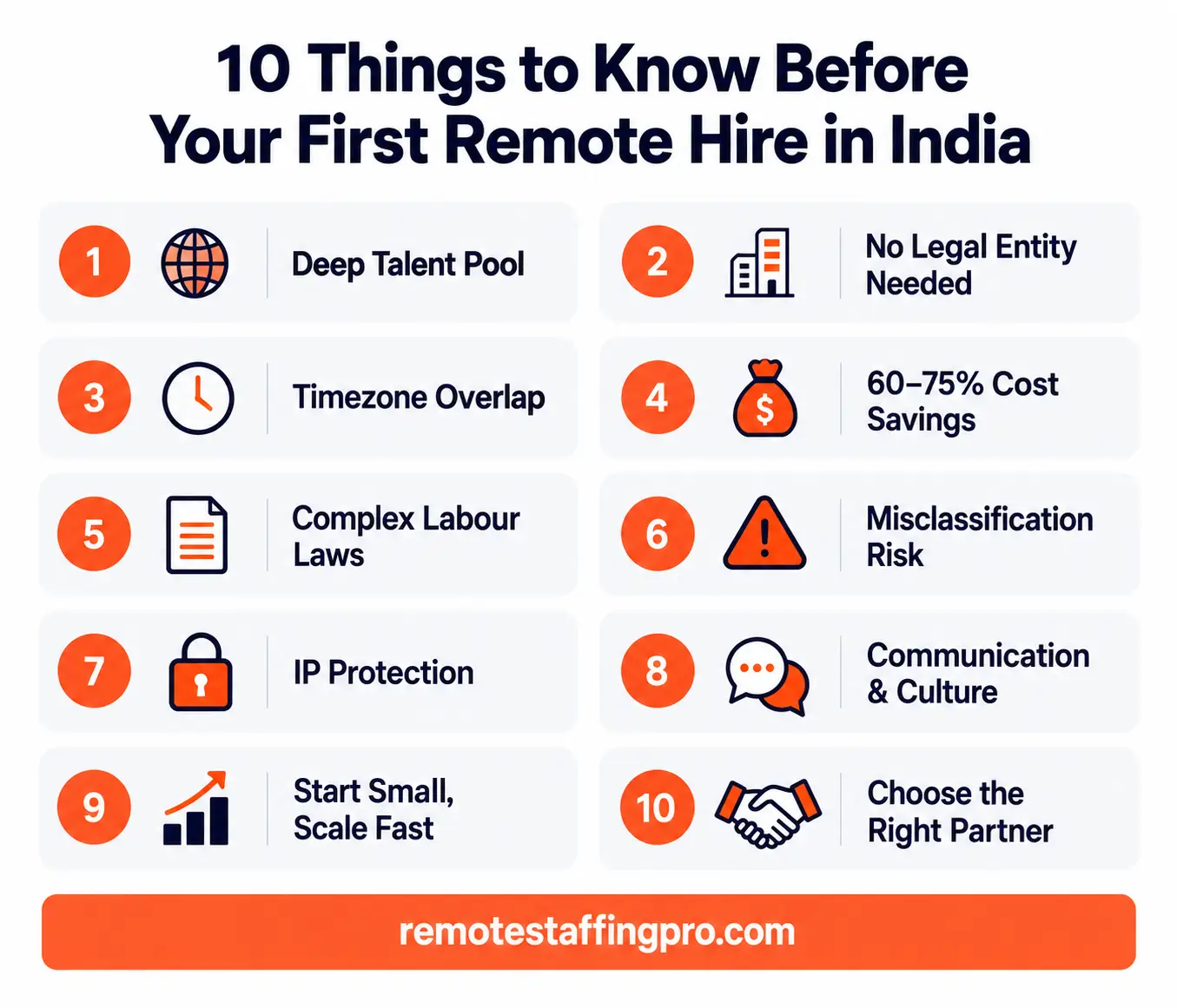
India is the world's number one destination for remote hiring — and it's easy to see why. With 9.5 million+ tech professionals, 1.5 million engineering graduates every year, fluent English proficiency, and salary savings of 60–75% compared to the UK, US, or UAE, the opportunity is massive.
But hiring remote employees in India for the first time comes with questions. How do you stay compliant? Do you need a legal entity? What about IP protection? How do you manage someone in a different timezone?
This guide covers the 10 most important things every international company should know before making their first remote hire in India in 2026. Whether you're a startup, SME, or scaling business — these insights will help you hire remote staff from India confidently and compliantly.
India Has One of the Deepest Talent Pools in the World
India produces 1.5 million engineering graduates every year. The country has over 9.5 million tech professionals and a rapidly growing workforce in design, marketing, finance, operations, and customer support. English proficiency is high across the professional workforce, making communication seamless for companies in the UK, US, UAE, Europe, and Australia.
Whether you need a developer, graphic designer, digital marketing specialist, accountant, or virtual assistant — India has the depth and quality to fill almost any role. This is why hiring remote employees in India has become the default strategy for cost-conscious, growth-focused companies worldwide.
The talent isn't just affordable — it's skilled. India's IT services industry alone generates over $250 billion in annual revenue, and the country is home to the world's largest freelancer population. When you hire remote staff from India, you're tapping into a proven, battle-tested talent ecosystem.
You Don't Need to Set Up a Legal Entity
One of the biggest misconceptions about hiring in India is that you need to register a company there. You don't. In 2026, there are multiple proven pathways to legally hire employees in India without setting up a legal entity.
- Employer of Record (EOR) — A locally registered company in India legally employs the worker on your behalf, handling contracts, payroll, PF, ESI, TDS, and all compliance. You manage the employee's day-to-day work. This is the most popular model for remote staffing India 2026.
- Managed Remote Staffing — A more comprehensive model that includes everything an EOR does, plus office infrastructure, IT equipment, and hands-on HR management.
- Contractor/Freelancer — Works for short-term, project-based work but carries misclassification risk if the relationship resembles full-time employment.
For your first remote hire India, an EOR or managed staffing model is the safest and most compliant route. Learn more in our guide on how to hire employees in India without a legal entity.
Timezone Overlap Works in Your Favour
One of the biggest concerns companies have about hiring remote employees in India is timezone management. But the reality is far better than most expect.
India Standard Time (IST) is UTC+5:30. This creates meaningful overlap with most major business regions:
| Region | Overlap with India | How It Works |
|---|---|---|
| UK | 4.5 hours | UK afternoon = India evening — ideal for daily standups and collaboration |
| UAE | 1.5 hours difference | Practically the same working day |
| Europe | 3–4.5 hours | European afternoon overlaps with India evening |
| US East Coast | 9.5 hours | Evening overlap — great for handoffs and morning standups |
| Australia | 4.5–5.5 hours | Morning overlap — Australian morning = India early morning |
For most companies, this overlap is more than enough for daily standups, collaborative work sessions, and real-time communication. Many Indian professionals are also flexible with working hours, especially in remote roles.
Cost Savings Are Real — But Understand the Full Picture
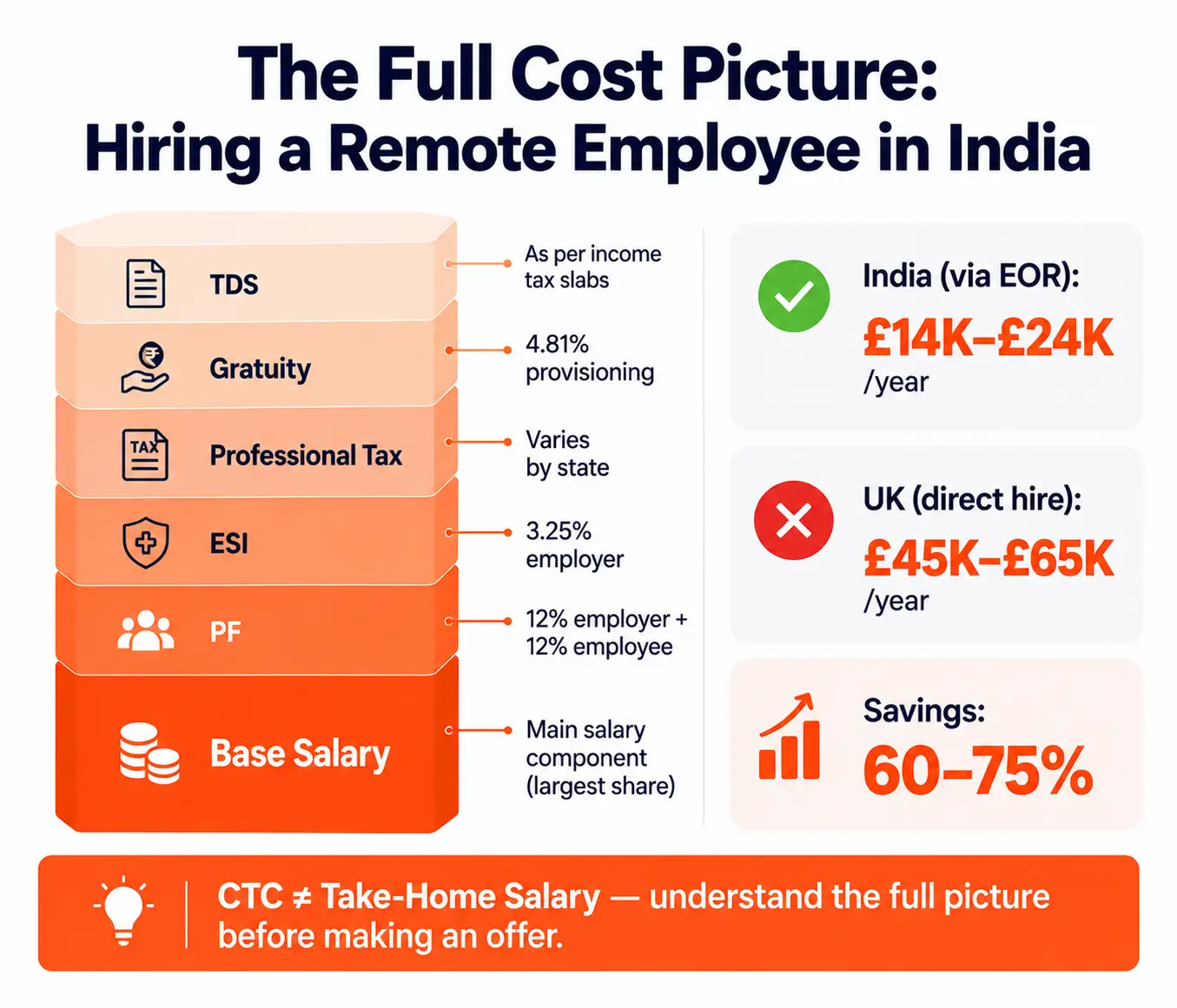
The headline number is compelling. Hiring remote employees in India saves 60–75% compared to hiring the same role in the UK, US, or UAE. A mid-level developer costs £14,000–£24,000/year (all-inclusive via EOR) versus £45,000–£65,000/year in the UK.
But it's important to understand the full cost picture. In India, the salary you offer is not the total cost. On top of the base salary, employers must contribute:
| Contribution | Rate | Notes |
|---|---|---|
| Provident Fund (PF) | 12% of basic wages | Employer + 12% employee contribution |
| ESI | 3.25% employer | For employees earning ≤ ₹21,000/month |
| Professional Tax | Varies by state | Typically ₹200/month |
| Gratuity | 4.81% provisioning | Payable after 5 years of service |
| TDS | As per income tax slabs | Deducted monthly from salary |
When you hire remote staff from India through an EOR, these statutory contributions are included in the total cost. Make sure you understand the difference between CTC (Cost to Company) and take-home salary before making an offer.
India's Labour Laws Are Complex — Don't DIY
India consolidated 29 legacy labour laws into 4 new Labour Codes that took effect from November 2025, with Central Rules published in May 2026. These codes cover wages, social security, industrial relations, and occupational safety.
Key changes that affect remote staffing India 2026 include:
- The 50% wage rule — basic salary + DA must be at least 50% of total CTC, directly impacting PF, ESI, gratuity, bonus, and overtime calculations
- Overtime — must be paid at twice the normal wage rate
- Maternity leave — 26 weeks, one of the longest in Asia
- Final settlements — must occur within 48 hours of the last working day
Unless you have a dedicated India HR and legal team, do not try to manage Indian labour compliance yourself. Use an EOR or managed staffing partner who stays updated with every regulatory change. This is especially important for your first remote hire India — getting compliance wrong from the start creates long-term liability.
Misclassification Risk Is Serious
This is one of the most common mistakes companies make when hiring remote employees in India. They engage someone as a "contractor" or "freelancer" — but the relationship looks like full-time employment:
- The person works fixed hours
- Uses company tools and systems
- Reports to a manager
- Works exclusively for one client
- Receives regular monthly payments
In India, this is considered misclassification — and it carries real consequences. The company can be held liable for unpaid PF, ESI, and other statutory contributions. Penalties and interest can be levied retroactively. The worker can claim employee rights including termination protection and gratuity.
IP Protection Needs to Be in the Contract
Under Indian law, intellectual property created by an employee generally belongs to the employer — but only if the employment contract explicitly assigns IP rights. Without a written IP assignment clause, the creator may retain rights to the work.
This is critical for companies hiring remote employees in India, especially in software development, design, and content creation. Your employment contract must include:
- IP assignment clause — transfers all work product to your company
- Confidentiality and NDA — protects sensitive business information
- Non-solicitation clause — prevents poaching of clients or team members (note: non-compete clauses are generally unenforceable in India)
When you use an EOR, these clauses are built into the India-compliant employment contract. If you're hiring directly, make sure your legal team reviews the contract for Indian law compliance.
Communication & Cultural Fit Matter
English fluency across India's professional workforce is high, and most remote professionals are experienced in working with international teams. However, there are cultural nuances worth understanding when you hire remote staff from India:
- Indirect communication — Indian professionals may avoid saying "no" directly, especially to senior stakeholders. This isn't dishonesty — it's a cultural communication style. Build a culture of open feedback where team members feel safe raising concerns.
- Set clear expectations — from day one, define deliverables, deadlines, communication frequency, and escalation paths.
- Use async-first tools — Slack, Loom, Notion, and project management platforms like Asana or Jira work well for distributed teams.
- Regular one-on-ones — schedule weekly check-ins to build rapport and trust. This is especially important for your remote employee India team members who may feel disconnected from the core team.
Companies that invest in communication and cultural integration see significantly better retention and performance from their remote teams in India.
Start Small, Scale Fast
Don't hire 10 people on day one. The smartest approach for your first remote hire India is to start small and scale based on results.
| Phase | Team Size | Timeline | Focus |
|---|---|---|---|
| Phase 1 | 1–3 employees | Month 1–3 | Test the model, build processes, establish communication rhythms |
| Phase 2 | 4–8 employees | Month 3–6 | Build a self-sufficient pod with a mix of roles |
| Phase 3 | 10–25+ employees | Month 6+ | Proven model — scale aggressively |
Most companies that start with 1–3 hires scale to 5–10 within 6 months. The key is to get the first remote hire India right, build trust, and then expand. This phased approach to remote staffing India 2026 minimises risk while maximising learning.
Choose the Right Hiring Partner
Your hiring partner makes or breaks the experience. Whether you choose an EOR, managed staffing provider, or recruitment agency — here's what to look for:
- Own entity in India — the provider should have their own registered company, not rely on sub-contractors
- Compliance track record — ask about their PF, ESI, and TDS filing history
- Transparent pricing — no hidden fees; the monthly cost should include all statutory contributions
- Recruitment support — some providers help with sourcing and shortlisting candidates, saving you weeks
- Scalability — can they support you as you grow from 1 to 50+ employees?
- Tax treaty expertise — they should understand Permanent Establishment risk under the relevant DTAA (UK-India, US-India, etc.)
Getting Started with Your First Remote Hire in India
Providers like Remote Staffing Pro offer end-to-end EOR and managed remote staffing services for international companies hiring remote employees in India. From candidate sourcing to compliant onboarding, payroll, PF, ESI, and HR management — everything is handled for you.
Whether you're a UK company, UAE business, European firm, or US startup — you can explore how it works or check pricing for more details.
✅ Bonus: Quick Checklist Before Your First Hire
- Define the role, skills, and experience level clearly
- Decide your hiring model — EOR, managed staffing, or contractor
- Understand the full cost — including PF, ESI, gratuity, and professional tax
- Ensure your contract includes IP assignment and NDA clauses
- Choose a compliant hiring partner with their own entity in India
- Set up communication tools and async workflows
- Plan for timezone overlap and meeting schedules
- Start with 1–3 hires and scale based on results
- Budget for onboarding and cultural integration
- Track performance with clear KPIs from day one
FAQs
Hiring a contractor or freelancer is the cheapest upfront, but carries misclassification risk. An EOR (starting at $99–$199/employee/month) is the most cost-effective compliant option for full-time hires. When hiring remote employees in India, compliance should always come before cost.
Through an EOR or managed staffing partner, you can onboard your first remote hire India within 1–3 weeks — from defining the role to day one. This is significantly faster than setting up your own entity (3–6 months).
You don't pay Indian corporate tax unless you trigger a Permanent Establishment. An EOR structure typically avoids this. However, the EOR handles all employee-level taxes — including TDS, PF, and ESI — on your behalf.
Yes. There is no minimum. EOR is ideal for companies making their first remote hire India who want to test the model before scaling. You can start with one remote employee India and grow from there.
Almost any knowledge-work role — including software developers, graphic designers, digital marketers, accountants, virtual assistants, content writers, data analysts, project managers, HR professionals, and customer support specialists.
Related Resources
Related Blog Posts
- How to Hire Employees in India Without a Legal Entity (2026 Guide)
- EOR India for UK Companies — A Complete Guide
- How UK SMEs Are Scaling with Remote Teams in India
- Why UAE Companies Are Hiring Remote Staff from India
- How Dubai Startups Are Building Remote Teams in India
- Remote Staffing from India for European Companies
- EOR vs Setting Up a Company in India

