

A complete guide for UK businesses looking to hire employees in India through an Employer of Record — covering how EOR works, compliance requirements, costs, DTAA protection, and how to choose the right partner in 2026. Whether you're a startup, SME, or enterprise — EOR India for UK companies is the fastest way to get started.

Why UK Companies Are Hiring in India
The UK is facing a persistent talent shortage — particularly in technology, engineering, finance, and digital marketing. According to the Office for National Statistics, job vacancies remain elevated across multiple sectors, and hiring timelines have stretched significantly. At the same time, salary expectations in the UK continue to rise, putting pressure on SMEs and startups with limited budgets. In 2026, the number of UK companies hiring in India has grown significantly — driven by talent shortages, rising salaries, and the need to scale quickly.
India offers a compelling alternative. With 9.5 million+ tech professionals, 1.5 million engineering graduates every year, and fluent English proficiency, India has the depth and quality to fill almost any role a UK company needs. The timezone overlap of 4.5 hours (IST UTC+5:30 vs GMT/BST) allows for meaningful real-time collaboration during UK afternoon hours. And the cost savings are substantial — 60–75% less than hiring the same role in the UK.
But hiring in India isn't as simple as posting a job and making an offer. India has one of the most complex employment compliance frameworks in the world. This is where an EOR India for UK companies becomes essential.
What is an Employer of Record (EOR)?
An Employer of Record is a locally registered company in India that legally employs workers on behalf of a foreign company. The EOR becomes the legal employer on paper — handling all employment contracts, payroll, statutory contributions, tax deductions, and compliance. Meanwhile, the UK company manages the employee's day-to-day work, tasks, and performance.
Think of it as a three-party relationship:
- The UK Company — defines the role, manages the work, and makes all business decisions
- The EOR India Partner — handles the legal employment relationship including contracts, payroll, PF, ESI, TDS, and compliance
- The Indian Employee — works for the UK company operationally but is legally employed by the EOR
This structure allows UK companies hiring in India to do so compliantly — without registering a company, navigating Indian labour laws, or managing local payroll. Using an employer of record India UK model, you can hire employees India UK without entity registration and start in as little as 1–3 weeks.
Why UK Companies Need an EOR to Hire in India
India's employment compliance landscape is complex, and the consequences of getting it wrong are serious. Here's why an employer of record India UK model is essential for UK businesses.
India's New Labour Codes (2025/2026)
India consolidated 29 legacy labour laws into 4 new Labour Codes. The Code on Wages, Code on Social Security, Code on Industrial Relations, and Code on Occupational Safety, Health and Working Conditions took effect from November 2025, with Central Rules published in May 2026. Key changes include:
- The 50% wage rule — basic salary + dearness allowance must be at least 50% of total CTC. This directly impacts PF, ESI, gratuity, bonus, and overtime calculations
- Overtime — must now be paid at twice the normal wage rate
- Gig and platform worker coverage — expanded social security provisions
These changes affect every employer in India — including those hiring through an EOR. Ensuring EOR compliance India UK means your partner must be fully updated with these new codes and their implications on salary structuring and statutory contributions.
Statutory Contributions Are Mandatory
Every employer in India must make the following statutory contributions:
| Contribution | Employer Share | Employee Share | Notes |
|---|---|---|---|
| Provident Fund (PF) | 12% of basic wages | 12% of basic wages | Mandatory for all employees |
| ESI (Employee State Insurance) | 3.25% | 0.75% | For employees earning ≤ ₹21,000/month |
| Professional Tax | — | Varies by state | Typically ₹200/month |
| Gratuity | 4.81% provisioning | — | Payable after 5 years of service |
| TDS (Tax Deducted at Source) | — | As per income tax slabs | Deducted monthly from salary |
An EOR India for UK companies handles all of these automatically — ensuring zero compliance gaps and no penalties. Maintaining EOR compliance India UK standards means your provider handles every statutory obligation — from PF and ESI to TDS and professional tax — without you lifting a finger.
Permanent Establishment (PE) Risk
This is a critical concern for UK companies. Under the UK-India Double Taxation Avoidance Agreement (DTAA), if your Indian employees are concluding contracts or running sales on your behalf, you could trigger a Permanent Establishment in India. This would make your UK company liable for Indian corporate tax on profits attributable to India.
An employer of record India UK structure — with employees performing support functions under the EOR's entity — typically keeps UK profits outside India's tax net. However, UK companies should consult a tax advisor to ensure their specific arrangement is PE-safe.
Termination Complexity
India has strict termination laws. Employees who have completed 240 days of continuous service cannot be terminated without following due process — including notice periods and severance pay. For establishments with 100+ workers, prior government approval may be required for retrenchment. An EOR handles all termination and offboarding compliance, protecting the UK company from legal exposure.
How EOR India Works for UK Companies (Step-by-Step)
Here's the typical process when UK companies hiring in India use an EOR:
Define the Role
The UK company identifies the role, skills, experience level, and compensation range. Whether you need a developer, designer, marketer, or accountant — you define the requirements.
EOR Drafts a Compliant Employment Contract
The EOR creates an India-compliant employment contract covering salary structure, leave policy, notice period, confidentiality, and IP assignment. The contract complies with all applicable Labour Codes and state-level regulations.
Employee is Onboarded Under the EOR's Entity
The employee is legally hired under the EOR's registered entity in India. The EOR handles PF registration, ESI enrolment, professional tax registration, and all statutory formalities.
UK Company Manages Day-to-Day Work
The UK company manages the employee's tasks, performance, and deliverables. The employee works as a dedicated member of the UK team — operationally integrated but legally employed by the EOR.
EOR Handles Monthly Payroll & Compliance
Every month, the EOR processes payroll, deducts TDS, contributes PF and ESI, files statutory returns, and manages leave records. The UK company receives a single consolidated invoice. This is how EOR compliance India UK works in practice — the UK company focuses on work, the EOR handles everything else.
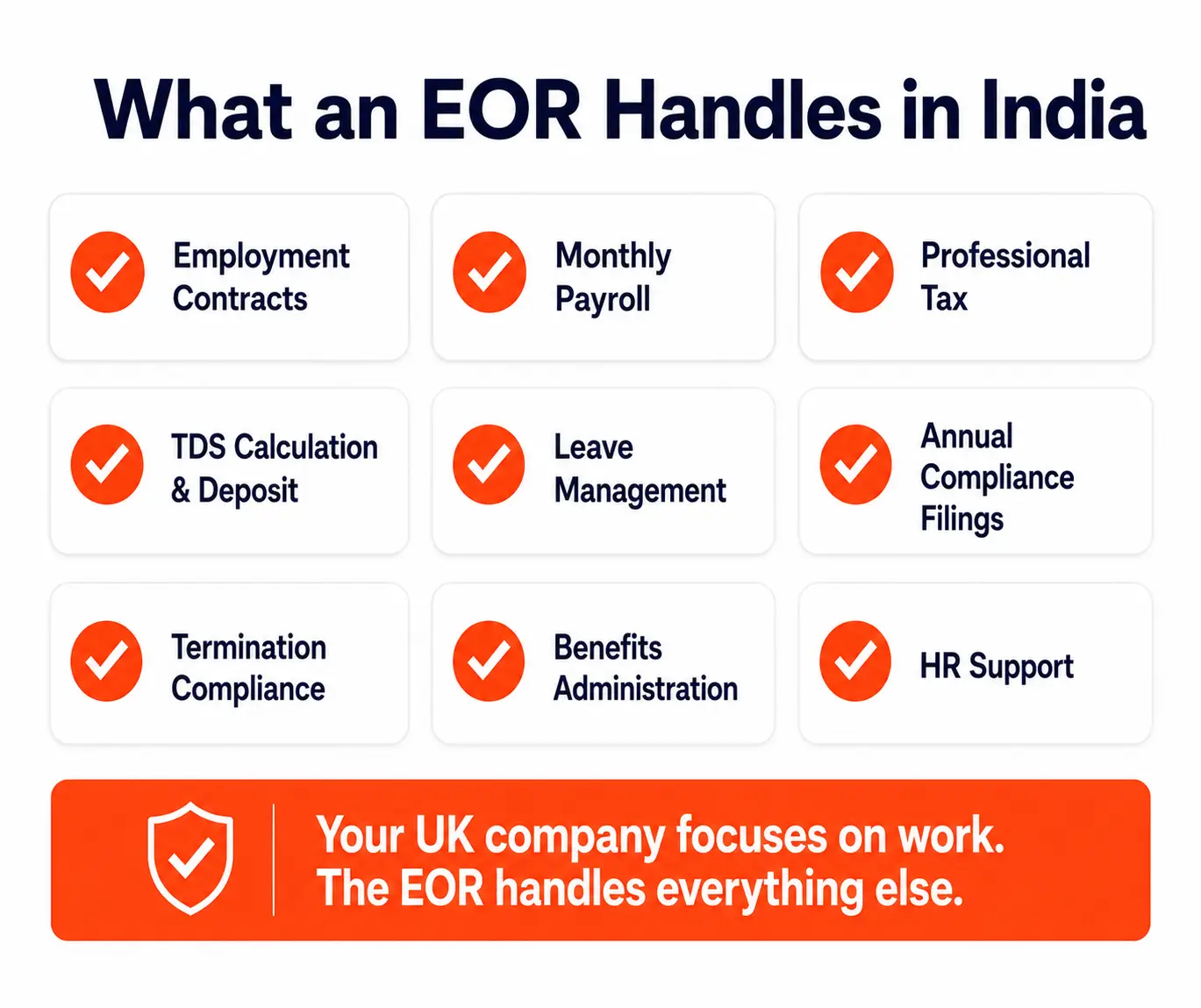
What Does an EOR Handle? (Full Scope)
Here's the complete scope of what an EOR manages when you hire employees India UK without entity registration:
This is the full scope of support you get when you hire employees India UK without entity registration — everything from contracts to termination is managed for you.
EOR India Costs for UK Companies
EOR pricing in India typically ranges from $99 to $699 per employee per month, depending on the provider, scope of services, and employee count. Here's what you can expect:
| Tier | Price Range | What's Included |
|---|---|---|
| Basic EOR | $99–$199/employee/month | Payroll processing, statutory compliance, basic HR support |
| Standard EOR | $200–$399/employee/month | + Recruitment support, benefits administration, dedicated account manager |
| Premium/Managed | $400–$699/employee/month | + Full-service recruitment, onboarding, office infrastructure, IT equipment, HR management |
EOR vs Setting Up Your Own Entity in India
For UK companies hiring in India, the choice between EOR and setting up a subsidiary is one of the most important decisions. Here's how they compare:
| Factor | EOR India | Own Entity (Subsidiary) |
|---|---|---|
| Setup Time | 1–3 weeks | 3–6 months |
| Setup Cost | Zero entity cost | $5,000–$15,000+ |
| Monthly Compliance | EOR handles everything | You manage (or hire locally) |
| Minimum Commitment | No minimum | Long-term commitment |
| Ideal For | 1–50 employees | 50+ employees |
| Compliance Risk | EOR assumes risk | You bear all risk |
| Flexibility | Scale up/down easily | Difficult to wind down |
For most UK companies — especially those making their first 1–20 hires in India — an EOR is the clear winner. You can always transition to your own entity later as headcount grows. Learn more about EOR vs setting up a company in India.
UK-India DTAA: How EOR Protects You from Double Taxation
The UK-India Double Taxation Avoidance Agreement (DTAA), signed in 1993 and modified by the Multilateral Instrument (MLI), prevents UK businesses from being taxed twice on the same income.
Under this treaty, if a UK company has a Permanent Establishment (PE) in India, the profits attributable to that PE are taxable in India. An EOR structure helps UK companies avoid triggering a PE because:
- Indian employees are legally employed by the EOR — not by the UK company
- Employees perform support functions under the EOR's entity
- This typically does not constitute a PE under Article 5 of the DTAA
EOR vs Other Hiring Models for UK Companies
EOR vs Contractor/Freelancer
An EOR gives you full-time, dedicated employees with benefits and compliance. Contractors are independent, and you risk misclassification penalties if the relationship resembles employment. EOR is better for long-term, dedicated roles. Contractors suit short-term, project-based work. If you want to hire employees India UK without entity setup and need dedicated team members, EOR is the right choice.
EOR vs Managed Remote Staffing
Managed remote staffing includes everything an EOR does — plus office infrastructure, IT equipment, and hands-on HR management. It's a more comprehensive solution, ideal for UK companies that want a fully managed team without any operational involvement. EOR is better for companies that want compliance coverage only, while managed staffing suits those who want end-to-end team management.
EOR vs Setting Up a Subsidiary
A subsidiary gives you full control but requires significant investment, time, and ongoing compliance management. EOR is better for 1–50 employees or when testing the India market. A subsidiary makes sense at 50+ employees with long-term commitment.
How to Choose the Right EOR Partner in India
Not all EOR providers are equal. Here's what UK companies should look for when evaluating EOR compliance India UK partners:
- Own entity in India — the EOR should have its own registered entity, not rely on sub-contractors. This ensures direct compliance control
- Compliance track record — ask about their PF, ESI, and TDS filing history. Any delays or defaults can create liability for your employees
- Transparent pricing — no hidden fees. The monthly cost should include all statutory contributions and compliance
- UK-India DTAA expertise — your EOR partner should understand PE risk and structure the arrangement to protect your UK company
- Scalability — can they support you as you grow from 1 to 50+ employees?
- Recruitment support — some EOR providers also help with sourcing and shortlisting candidates, saving you time
How Remote Staffing Pro Supports UK Companies
Providers like Remote Staffing Pro offer end-to-end EOR services for UK companies hiring in India — covering recruitment, compliant onboarding, payroll, PF, ESI, and HR management, all without requiring you to set up a legal entity.
Whether you're hiring your first employee or scaling to a team of 25+, the entire process — from candidate shortlisting to compliant onboarding — is handled for you. You can explore EOR India services, learn how it works, or check pricing for more details.
For UK-specific hiring, visit the UK companies page to see how other UK businesses are already hiring remote staff from India.

FAQs
Yes. Using an Employer of Record is entirely legal in India. The EOR is a registered Indian company that legally employs staff on your behalf. This model is widely used by UK, US, European, and Australian companies hiring in India. Thousands of global companies hire employees India UK without entity setup every year using this model.
Most EOR providers can onboard an employee within 1–3 weeks from contract signing to day one. This is significantly faster than setting up your own entity, which takes 3–6 months.
Not typically. When structured correctly — with employees performing support functions under the EOR's entity — it does not trigger a PE under the UK-India DTAA. However, if employees are concluding contracts on your behalf, consult a tax advisor.
There is no minimum. You can start with just 1 employee and scale as needed. EOR India for UK companies is ideal for businesses making their first hires in India.
Yes. Many UK companies start with an EOR for their first 10–20 hires and then transition to their own subsidiary once headcount and commitment justify the investment. A good EOR partner will support this transition.
The EOR handles all termination compliance — including notice periods, severance calculations, final settlement, and statutory dues. This protects the UK company from legal exposure under Indian labour laws.
Related Resources
Related Blog Posts
- How UK SMEs Are Scaling with Remote Teams in India
- How to Hire Employees in India Without a Legal Entity (2026 Guide)
- EOR vs Setting Up a Company in India
- Why UAE Companies Are Hiring Remote Staff from India
- Remote Staffing from India for European Companies
- How Dubai Startups Are Building Remote Teams in India
